Prologue
This is a article that I have submitted to a Winter School in Astrophysics and Cosmology for the first week project, and I guess it is nice to share the information here.
Throughout my pursuits in undergrad, I’ve always been more of a “Take it for granted” person — someone who uses well-prepared and processed datasets like SDSS or NED, rather than the person who actually goes out and takes the data. Still, this part of astronomy is both the one I hate and love (to some extent). It’s exciting to imagine obtaining an image yourself, understanding every step of how it’s formed, and staring at your beautiful product for hours (and this is usually the best part of it); but it’s also extremely tedious and technical. Without proper knowledge (in this case mostly engineering knowledge), it’s almost impossible to get anything useful out of it, and all the mess and fuzz that you obtained throughout the way quickly demotivates you to work on it more.
However, since it’s the first week of winter school, I thought I might as well take on something unfamiliar. It feels like a good chance to challenge myself with a topic that I barely know, rather than staying safe and writing about something I already have quite some knowledge on. (Although, knowing myself, I might regret it later and crawl back to my comfort zone in the following weeks, but we’ll see how it goes.)
Introduction
For most of human history, astronomy was done with nothing but the naked eye. People looked up, tracked the stars, and noticed patterns across the sky. Back then, there wasn’t even a clear distinction between clouds, lightning, stars, or comets, they were all just mysterious things above us, and all of them used to be called astronomy. Many stories and myths are constructed to explain phenomena in the sky, and some became tools or weapons of the throne and power. (Refer to how older days, where church focuses on geocentric model and accusing the heliocentric model; the Mayans god of Sun, reflecting the throne power being granted by God; comets bringing bad luck; the Greek with numerous myths around objects the sky)
Today, astronomy has grown to mean “the study of everything beyond Earth.” (Everything on the sky but within Earth’s atmosphere, like clouds or auroras, is now the weather forecasters and meteorologist’s job, however to my knowledge, there are no clear boundaries yet between them).
As civilization developed, we started to realize that the sky isn’t static, stars rise and set, constellations shift through the seasons, and the planets move across the background of stars. These motions made it necessary to build tools to record positions accurately and track celestial changes. Initially, we started with wooden sticks plunged on the ground, marking shadows on the ground, and slowly evolved into small refracting telescopes, then massive observatories mounted on mountains, and eventually to highly sensitive detectors that can “see” not just visible light but all forms of electromagnetic radiation, and some are located even beyond the Earth.
Nowadays, astronomy doesn’t stop at electromagnetic waves anymore — we’ve extended our senses to include gravitational waves with detectors like LIGO and VIRGO, and even neutrinos with experiments like IceCube. It’s incredible to think how a discipline that started from simply watching the sky has now reached the level of listening to the faint ripples of spacetime and watching some particle streams. (it is also right to question, whether these are still considered observations or not? Or should we change to astronomical information analysis)
Still, no matter how advanced our tools have become, the principle behind every observation remains the same: we are trying to gather and interpret signals from the universe. Every improvement in instrumentation, from the first telescope to modern CCDs and radio arrays, basically scripted a story about how we collected more and better information from the universe itself.
In this article, I will explore some of these observational tools, focusing particularly on telescopes, CCDs, bolometers, and scintillators, which represent the major ways we capture and translate signals across different wavelengths. I’ll also try to touch a bit on how each of them changed the way we see the universe, literally and figuratively.
Telescopes - The Photon Collector
(Chapter 1.1.18 to Chapter 1.1.20, Telescopes, Astrophysical Techniques, Kitchin, C. R., 2013)
Introduction:
Telescopes are made from lenses or mirrors mounted together, using the concepts of focal length, Snell’s Law and knowledge in optics, to construct a device, capable of making something extremely far from us, seem large and close to us. The telescope is always the bread and butter of anything in astronomy, and it became so prominent that we forget that telescopes do not help us to detect anything at all, it is just a device to help us collect photons, and the detector is always our own eyes (It might be extremely intuitive to the reader that this is the case, but for me I found it amazing). Thus, Bishop Robert Grosseteste (c. 1175–1253) writing in De Iride (The Rainbow) says:
“This part of optics, when well understood, shows us how we may make things a very long distance off appear as if placed very close and large near things appear very small and how we may make small things placed at a distance appear any size we want, so that it may be possible for us to read the smallest letters at incredible distances, or to count sand, or seed, or any sort of minute objects.”
There are many designs to telescopes, and some of them stood through the test of time and still are widely known even today. It all started with the refractor (Gallilean, Lipperhey and the most famous Kepliaran types) but they are highly limited with chromatic aberration, and the practical difficulty of designing a flawless large lens, which also requires a lengthy tube with it.
Soon, the reflector telescopes was invented (Gregorian, Cassegrain and Newtonian telescopes), it solved the problem for chromatic aberration, and improved the light gathering power and resolution, however it is no where enough, and the need of mammoth structure is still essential, which is near impossible at the moment of time. Reflectors also have their own set of weaknesses, though they are solved throughout the years (the speculum metal coating replacement for mirrors being one of them).
There is a limit on how big telescopes can go, since designing an extremely long tube and an extremely large clean lens is practically increasingly impossible. The technology developed to incorporate multiple small mirrors, using interferometry to create a huge picture. It advanced and larger areas (VLA, SKAO are examples of them, although they are practically radio antennas) were covered, and essentially combination of Earth’s movement observations and cross country collaboration became what we denoted as “telescopes nowadays” (M87 being one of the most famous example).
Telescope Theory
(Chapter 6, Optical Telescopes, Observational Astronomy, D. Scott Birney, 1993)
The telescope works under the same principles of optics in any physics textbook, and honestly, you’d probably get a clearer explanation there than from my rough summary. But still, it’s worth mentioning some essentials (for my article purpose obviously), especially how telescopes form images and what limits their resolving power.
Telescopes are dominantly used as the photon collection device, rather than a device solely to magnify objects. The light gathering power of a telescope is given by:
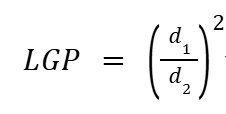
where d is the diameter of the objective diameter of the telescope
If we use d2 as the diameter of our eyes (which is around 7mm), we can compare how well the telescope is collecting photons in comparison to what we see ourselves (e.g.: A 70mm diameter telescope collects light 100 times better than our eyes).
However, collecting photons is not sufficient enough, since gathering enormous amounts of light without resolving the details is impractical, and it is highly limited by the Fraunhofer diffraction (far-field diffraction), due to the wavelike nature of photons, forming Airy disks and diffraction rings. The smallest aperture required to barely separate between two objects (just barely, we still need better telescopes to see details even clearer) is given by the Rayleigh criterion, where:
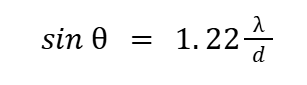
Despite being able to estimate the effects of diffractions that will cause changes on the image, there are still some deviations apart from the ideal patterns expected. The few common types of aberration are spherical, coma, astigmatism, distortion and field curvature. There are also possibly vignetting, and some problems in the manufacturing of the lenses and mirrors, which create even more deviation to ideal situations. There is also a common chromatic aberration in refracting telescopes, where the issue is resolved by using reflecting mirrors.
The Detectors - Charged Coupled Devices (CCDs)
Introduction:
(Chapter 8, Light Detectors, Observational Astronomy, D. Scott Birney, 1993)
After collecting all the photons, we require an observer, and whether it be the eyes, bolometers, scintillators or many more, the most famous (besides our own eyes, of course) among all of the detectors is the charged coupled devices (CCD).
A CCD is a two-dimensional array filled with metal insulator semiconductor (MIS) photosensitive capacitors (pixels), which is essentially an array of light-sensitive capacitors. They are made of a grid of tiny pixels, each capable of converting incoming photons into electrical charges through the photoelectric effect. Then, the electron is promoted from the valence band to the conduction band. The accumulated charge is then transferred down the columns through the charge coupling mechanism, where the voltage pattern is stored and an image is created. CCD designs and developments are often accompanied with the semiconductor developments (which I am not familiar with), and it has become much more stable and sensitive over the years.
Calibration:
(The AAVSO CCD Observing Manual, Manual, C. O., 2009)
CCD does not produce perfect images in the first place, since raw images are contaminated by a lot of random noises, and calibration is required to obtain a scientifically usable image. Usually, the three standard process for CCD calibration are given by:
-
Bias Frames - where an image with zero exposure time is taken with the shutter disabled.
-
Dark Frames - an exposure where the shutter is opened but no light is allowed to enter the shutter (mainly to eliminate dark current produced by the CCD itself). It is usually common to follow the “Image-Times-Five” Rule, where the dark frames are required to be obtained 5 times the amount of time for normal images, preferably in between observations sessions (rather than a one go full dark frame taking).
-
Flat Frames - take the picture of a uniform light source to eliminate some common sources of flat frames (e.g.: dust, vignetting, poorly aligned optics and many more). There is no absolute method for calibration of flat frames, and it came up to the user’s creativity and experience to make up with the best flat frame calibration method.
Data to Image:
CCDs are not cameras in any way possible, they are just a device to detect photons, and they are monochromatic. Through the use of filters, we could add colors of our own choice to different wavelength bands from the data collected. The vivid astronomical pictures seen are usually done with numerous post-processing processes, to create the most visually appealing image to the community.
The Detectors - Scintillators and Bolometers
(Chapter 8, Light Detectors, Observational Astronomy, D. Scott Birney, 1993)
(Chapter 1.1.15.2, Bolometers, Astrophysical Techniques, Kitchin, C. R., 2013)
(Chapter 1.1.3.3, Scintillators Detectors, Astrophysical Techniques, Kitchin, C. R., 2013)
Besides CCDs, there are other detectors that are equally useful as the CCDs, notably the scintillators and bolometers, yet they function through very different mechanics and techniques.
Scintillators are dominant in the higher energy regime, particularly X-ray detections. When a high energy photon reaches the surface, they interact and knock out the outermost electrons, creating a hole, recombination of the electron will emit radiation in the process, and the detection of these radiation using a photodiode or photomultiplier is known as a scintillator device. Some modern scintillators used sodium iodide (NaI) and caesium iodide (CsI) superimposed together and detected separately.
Bolometers, on the other hand, detect radiation through heating, and are particularly useful especially in the infrared region, where photon energies are usually too low to produce strong photoelectric effects. When bolometric elements are heated by the radiation, its resistivity changes, and the balance of the Wheatstone bridge is disrupted, which would be detected through the bridge. Bolometers thus provide a highly sensitive means of detecting faint infrared signals that other detectors might miss.
Conclusion
Throughout the years, humanity has forged upon many astronomical tools to help with the observations and detections, and slowly expanding our knowledge of us on the Universe with invisible electromagnetic radiations.
Many of the astronomical tools are being redeveloped, replaced or left out among the years, and some stood strong and remain efficient till now. No matter what, we humans have devised many tools for the curiosity of the vast Universe itself, and the improvements to it have never stopped till now.
Most tools possessed problems in their own way, due to the wavelike nature of photons, and many possible interference and noises throughout the detections, even with problems of the materials itself. It remained wondrous for humans to understand, and devote useful strategies to eliminate or work around most of them, creating ever more accurate and detailed pictures for the scientific community.
As more of a data-driven person, it is still fabulous to me among all the wonders created by the observers and data collectors, as the difficulties and challenges to collect them for our usage, and the processes and techniques developed, felt amazed to me, and made me appreciate their data more when using them for my own research purposes.
References
Manual, C. O. (2009). The AAVSO CCD Observing Manual.
Kitchin, C. R. (2020). Astrophysical techniques. CRC press.
O’Sullivan, T. (1993). D. Scott Birney, observational astronomy, Cambridge University Press, Cambridge, 323 pp.,£ 14.95, ISBN 0 521 396 93X.